Nutritional and Immune Support for Horses
 "In their natural state horses
naturally move around for most of the day and possibly some of the night.
Confined in a stable for at least part of the day, a horse needs additional
exercise if he is to avoid becoming stiff and overweight, and losing muscle
tone. Indeed, it can be dangerous for a horse to stand in a stable for
several days in a row, unless it is absolutely necessary because of
illness or injury.
"In their natural state horses
naturally move around for most of the day and possibly some of the night.
Confined in a stable for at least part of the day, a horse needs additional
exercise if he is to avoid becoming stiff and overweight, and losing muscle
tone. Indeed, it can be dangerous for a horse to stand in a stable for
several days in a row, unless it is absolutely necessary because of
illness or injury.
Standing motionless or almost motionless for hours
on end slows down the circulation, which can lead to a build up of toxins.
When a horse stands for any length of time (as in a human being confined to bed)
muscle tone is lost, and this in turn weakens the whole body. When the horse
starts to work again, he will be more susceptible to injury. He will also be
vulnerable to cold when he first goes out if the weather is bad. Digestive
problems can occur. A healthy but inactive horse may well put on weight."
Jan Agar Bergeron D.V.M.
The Horse's Immune Response
Some of the finest horse trainers have recognized that a product that provides
overall immune system building can help horses in breeding, racing, eventing
and recovering from injury or stress. They use a product known for its immune
boosting properties. This immune support also acts as a preventive measure.
Healing is facilitated as well, and some trainers comment on how quickly
their horses recover from races when they're on a regime including this supplement.
 A foal with joint ill had been lame for
3 days with an extremely swollen hock and a 104.5 temperature.
I recommended that this foal be hospitalized due to the severity of
infection, but the client could not afford such care. I then
recommended penicillin injections daily and transfer factors,
3 caps 3 times daily. The foal received only 2 injections of
penicillin, but a full course of this immune booster 48 hours
later, my client reported a remarkably quick recovery with normal
temperature and appetite with no apparent lameness.
A foal with joint ill had been lame for
3 days with an extremely swollen hock and a 104.5 temperature.
I recommended that this foal be hospitalized due to the severity of
infection, but the client could not afford such care. I then
recommended penicillin injections daily and transfer factors,
3 caps 3 times daily. The foal received only 2 injections of
penicillin, but a full course of this immune booster 48 hours
later, my client reported a remarkably quick recovery with normal
temperature and appetite with no apparent lameness.
Victor, a 10-year-old gelding, with EPM was treated with
conventional drug therapy for 5 weeks and yet continued to
deteriorate. At week 6, I started him on an immune support
formula (6 caps/day). Within one week, he showed noticeable
improvement, and within 30 days, he was able to show. Since
his full recovery 4 months ago, Victor has continued to show
at his original performance level.
A 19-yr-old late gestation mare had stringhalt, ataxia, and
moderate ear droop. I began the mare on this immune modulator
to improve its immune function prior to foaling. After 30 days
of being on this formula, this mare had no evidence of stringhalt
or ataxia, and only a mild ear droop. This is the first time in
her life she was able to pull her ear forward in a normal position.
She also is cushionoid and suffered miserably in last summer's heat,
being unable to sweat. This spring, when temperatures reached 80 degrees,
she was sweating in the field.
There was a 14-year-old quarter horse with a long history of
depression and high eosinophil count. I used a unique equine product
on this horse on the presumption that he suffered from some kind of
allergy or possible cancer. This horse responded tremendously with
his attitude. (i.e., much more energy and enthusiasm) but his blood work has remained unchanged.
 I had a 9-yr-old quarter horse mare named
Annie. She started colicking on a Sunday and was suffering from a severe
compaction. It became obvious by the second day that we were not dealing
with a normal colic. She was showing some neurological signs and her
temperature would bounce from 96 to 102. Our vet, Mike Marrinan, came out
every day to tube her with mineral oil and give her IVs. Her blood test
showed her liver and kidney functions were off, as was her blood count.
On day three her gums were bright fuschia, her pulse was 78 and her
capillary refill time was 4 seconds; we thought we were going to lose
her. Day four she started passing stools. Day five she got severe
diarrhea. The diarrhea and depression lasted for five days. She lost
about 200 pounds and her coat turned coarse and dull. She had patches
of skin that were sloughing and her extremities were swelling, including
her face. All of these were signs that she was fighting something toxic.
I started her on a special immune
support formula for horses. After four days of being on that she
started eating aggressively, jigged to the pasture, and her eyes
were bright and clear. She has put most of her weight back on.
Annie was 30 days pregnant when she colicked, you can't imagine
our joy when we did a 65-day ultrasound and saw her fetus doing
back flips. We continue to feed Annie this amazing immune product
throughout her pregnancy. I am convinced that Transfer Factor is
helping her body fight and the probiotics are aiding in the digestion and healing her gut.
I had a 9-yr-old quarter horse mare named
Annie. She started colicking on a Sunday and was suffering from a severe
compaction. It became obvious by the second day that we were not dealing
with a normal colic. She was showing some neurological signs and her
temperature would bounce from 96 to 102. Our vet, Mike Marrinan, came out
every day to tube her with mineral oil and give her IVs. Her blood test
showed her liver and kidney functions were off, as was her blood count.
On day three her gums were bright fuschia, her pulse was 78 and her
capillary refill time was 4 seconds; we thought we were going to lose
her. Day four she started passing stools. Day five she got severe
diarrhea. The diarrhea and depression lasted for five days. She lost
about 200 pounds and her coat turned coarse and dull. She had patches
of skin that were sloughing and her extremities were swelling, including
her face. All of these were signs that she was fighting something toxic.
I started her on a special immune
support formula for horses. After four days of being on that she
started eating aggressively, jigged to the pasture, and her eyes
were bright and clear. She has put most of her weight back on.
Annie was 30 days pregnant when she colicked, you can't imagine
our joy when we did a 65-day ultrasound and saw her fetus doing
back flips. We continue to feed Annie this amazing immune product
throughout her pregnancy. I am convinced that Transfer Factor is
helping her body fight and the probiotics are aiding in the digestion and healing her gut.
Friesian Gelding Recovers from Severe Dermatitis
9-yr- old Friesian gelding developed severe dermatitis in January
2001. The gelding went from being a beautiful black horse with full
mane and tail to having huge bald spots all over his body. He lost
his entire mane and most of his tail. Our vet, Mike Marrinan,
visited twice weekly to do Betadine scrubs and he put Prince on antibiotics.
 Dr. Marrinan took biopsies and sent them to two universities. He spoke with numerous specialists,
but none could tell us what was wrong. Our last resort was to put him
on steroids. His lesions gradually cleared and his hair started to grow
back. By the summer of 2001 we were again riding Prince; however, it
became evident that the side effects
of steroids were negatively affecting him. He was not holding his
weight and became spooky and unpredictable.
Dr. Marrinan took biopsies and sent them to two universities. He spoke with numerous specialists,
but none could tell us what was wrong. Our last resort was to put him
on steroids. His lesions gradually cleared and his hair started to grow
back. By the summer of 2001 we were again riding Prince; however, it
became evident that the side effects
of steroids were negatively affecting him. He was not holding his
weight and became spooky and unpredictable.
In the fall of 2001 Dr. Marrinan decided to gradually take him off steroids.
Two weeks after he concluded steroid use, a fresh lesion appeared on his face.
His immune system was severely compromised, White blood count was 3000
(normal is 15,000). He developed a chronic eye infection and then really
got sick. His fever spiked, he became depressed, and stopped eating and
drinking. Dr. Marrinan tried Sulfa drugs and IV's for three days.
He put him on Naxel; nothing worked. Prince had given up; we were
sure he was dying. I came across an article in The Horse regarding
the immune system. It spoke of a unique immune modulating supplement.
Upon finding an ad for the product I called Dr. Marrinan and asked
him about it. He said, "try it, nothing else is working."
I got a two week allotment of this supplement. We didn't want to
commit to more; we had already spent thousands of dollars on Prince.
There comes a time when you have to be realistic and say enough is
enough. After ten days on this immune support product, brightness
came back into Prince's eyes which we hadn't seen in months. His appetite increased and he was
drinking water again. I called my friend and ordered special formula
for horse. After two weeks his coat started getting glossy again
and his appetite returned. Two and a half months later he is
fully recovered! He is playing in the field again; his mane
and tail are growing back; his dermatitis is gone; and his
eyes are bright and clear! It is so awesome to see Prince
running across the field kicking up his heels with his
pasture pals! I truly believe that this immune supplement
has saved Prince's life.
Equine Protozoa Myeloencephalitis (EPM)
A new paradigm for the treatment and prevention of infections and
stress induced immune suppression
R.H. Bennett Ph.D.
 Introduction: EPM and other chronic diseases of horses and other mammals have a
pattern of wide geographic exposure to significant proportions of an animal
population, yet a small subset of the exposed progress to clinical disease.
This proportionality suggests that other modifying factors have a major
role in disease expression. The case in point here is EPM. There is wide
environmental exposure, as evidenced by seroconversion, yet only 1 to 2
percent become clinically affected. The phenotype of the individual most
likely is a major determinant.
Introduction: EPM and other chronic diseases of horses and other mammals have a
pattern of wide geographic exposure to significant proportions of an animal
population, yet a small subset of the exposed progress to clinical disease.
This proportionality suggests that other modifying factors have a major
role in disease expression. The case in point here is EPM. There is wide
environmental exposure, as evidenced by seroconversion, yet only 1 to 2
percent become clinically affected. The phenotype of the individual most
likely is a major determinant.
Horses that are highly genetically selected for performance or type traits most
likely lose genetic potentials for robust immune responsiveness, as is the case
for most species. Those individuals that experience the stressors of transportation
and training may then present a phenotype that is immunologically stress sensitive.
This subset is apparently small, but may be the group most likely to succumb to
immune challenges like that of EPM. The question then is how can the immune
abilities of the animal be supported to restore these phenotypic challenges?
Neurologic disease in horses caused by Sarcocystis neurona is difficult to
diagnose, treat, or prevent, due to the lack of knowledge about the
pathogenesis of the disease. This in turn is confounded by the lack
of a reliable equine model of equine protozoal myeloencephalitis (EPM).
Epidemiologic studies have implicated stress as a risk factor for this
disease, thus, the role of transport stress was evaluated for
incorporation into an equine model for EPM.
Sporocysts from feral opossums were bioassayed in interferon-gamma gene
knockout (KO) mice to determine minimum number of viable S. neurona
sporocysts in the inoculum. A minimum of 80,000 viable S. neurona
sporocysts were fed to each of the nine horses. A total of 12 S.
neurona antibody negative horses were divided into four groups (1-4).
Three horses (group 1) were fed sporocysts on the day of arrival at
the study site, three horses were fed sporocysts 14 days after
acclimatization (group 2), three horses
were given sporocysts and dexamethasone 14 days after acclimatization
(group 3) and three horses were controls (group 4).
All horses fed sporocysts in the study developed antibodies to S.
neurona in serum and cerebrospinal fluid (CSF) and developed
clinical signs of neurologic disease. The most severe clinical
signs were in horses in group 1 subjected to transport stress.
The least severe neurologic signs were in horses treated with
dexamethasone (group 3). Clinical signs improved in four horses
from two treatment groups by the time of euthanasia (group 1,
day 44; group 3, day 47). Post-mortem examinations, and tissues
that were collected for light microscopy, immune-histochemistry,
tissue cultures, and bioassay in KO mice, revealed no direct
evidence of S. neurona infection. However, there were lesions
compatible with S. neurona infection in horses. The results of
this investigation suggest that stress can play a role in the
pathogenesis of EPM. There is also evidence to suggest that horses
in nature may clear the organism routinely, which may explain the
relatively high number of normal horses with CSF
antibodies to S. neurona compared to the prevalence of EPM.
Related: Immune Boosting Supplements in Holistic Veterinary Care

Homeopathy Relief for Horse's Colic
Spasmodic Colic caused by eating green foods (rich alfalfa)
with severe abdominal pain, distention, loud intestinal noises.
Pains come in waves. Horse turns head toward flank, hunches back upward, strikes at belly. Tends to stand
but better when moving. Intermittent shivering then hot. Cramping, slimy
stools, sometimes with blood.
The homeopathic remedy Colocynthis is the
first choice for episodes of colic pain, particularly when the cause is
unknown. The horse is restless with the pain and wants to lie down. Pain
can be sudden, violent, and cramping making the horse want to bend over
double (seen by a hunched over appearance). The pain of Colocynthis is
twisting, contracting and distorting with neuralgic paroxysmal pains that
can be likened to what the horse will be feeling from acute digestive affections.
The pain may improve after passing stools or flatus. This remedy can also
be helpful in pains of the small joints and hips, 'as if dislocated', e.g.
slipping stifles. The symptoms may be worse in damp or cold weather. The
Colocynthis horse may be irritable and indignant.
Always a possible life-threatening condition, colic can come on suddenly,
Dr. Shulze - "90% of horses that die, do so because of what
is called colic, which is just intestinal blockage or intestinal spasms."
paralyzing a horse in both panic and pain, and his human with undeniable
fear. In every colic event, time is of the essence. Homeopathic remedies
offer you a viable, non-toxic, fast-acting, holistic approach to treating colic.
No barn or tack box should be without it!
Dr. Christina Chambreau, DVM - "A veterinarian in Texas stopped vaccinating
her horses and the incidence of colic decreased by 95%, a chronic foundering horse
became asymptomatic and all 17 horses were healthier in many ways. When she
vaccinated the herd 5 years later because of a panic over one disease, the colics,
flus, and even founder symptoms recurred. A veterinarian in Saskatchewan stopped vaccinating his large
beef herd 14 years ago and within 2 years there was a 75% decrease in his herd mortality.
Related:
Licking Colic with Homeopathy - Eight Helpful Remedies
Homeopathy for Horse Injuries
Bruising, swelling and inflammation can be treated successfully, and
most people now know the value of arnica in treating bruising and also
before and after operations. Rhus Tox and Symphitum work well with tissue,
connective tissue and old scar tissue and joints, and
 bone (symphitum being
the homeopathic form of comfrey which is well known to help heal bones.)
Calendula is a wonderful antiseptic, and can take its place in one's first aid box.
bone (symphitum being
the homeopathic form of comfrey which is well known to help heal bones.)
Calendula is a wonderful antiseptic, and can take its place in one's first aid box.
One of my clients horses exhibited a very strange lameness behind. I
suggested she call the vet, and the horse was diagnosed with a blood clot.
There is not much that can be done for a blood clot, but we put the horse
on a homeopathic remedy, and although the vet did not hold out much hope
for the horse, she recovered and is back in work, the blood clot is gone
but we keep a very close eye on her.
With scar tissue from old injuries which so many horses have, and which
is often not discovered until the horse is put under pressure in its work,
I find homeopathic remedies work really well. With chronic conditions like
arthritis, remedies can make the horse more comfortable for quite a long
time, and I believe that even navicular disease has responded to homeopathy.
In the case of minor injuries you can always administer Rescue
Remedy first about ten drops just on to the horses tongue or if you can
under the tongue. At this stage have some yourself, to keep you calm
and thinking straight.
SIGNS OF HORSE UNDERLYING ENERGY IMBALANCE
Christina Chambreau, DVM
- MIND: cribbing and/or weaving; pen/stall walking; flank sucking; over-reactive; fearful, excessively territorial
or aggressive; Fear of loud noises, slightest noises, narrow spaces.
- SKIN, RESPIRATORY: puffy around eyes; chronic conjunctivitis; dull eyes; "foal snots"; asthma sweat on
upper body but not lower, sticky sweat, unpleasant odor, dry and/or dull
hair coat, dry skin, poor-healing wounds, greasy skin on face.
- STOMACH: foul breath, fissures at corners of mouth, salivation from clover, hollow seeming teeth, hard
to float, loose teeth at under 20 years old, coprophagia/pica, craves salt,
fussy eating, intolerant to fat, repeated colics, sensitivity to weather
changes with GIT signs, excessively susceptible to parasites, potbellied foals,
distended abdomen (hay belly) in adults, rectum tears easily when
palpated, hard dry fecal balls.
- EXTREMITIES: warm up very slowly; stiff muscles; tie up if not warmed up; swollen legs: hot or cold may or
may not go down with exercise; unable to lift back feet; unable to balance
on three legs, bad odor without pathology, excessive moisture in feet,
sensitive to hammering in nails
- GENERALITIES: poor exercise tolerance; fat deposits- cresty necks, around tail head, top of croup,
etc; disturbed by temperature changes; offensive odors; not wanting touching,
grooming.
Why do Horses Eat Manure?
Dr. Christine King- "Manure eating (coprophagia) can be normal behavior
in horses. In young foals, eating the mother's manure is a normal developmental
stage. Through this behavior the foal learns to explore his environment
and use his senses to make choices about what is palatable and what is
not. He is also getting some dietary fiber and the beneficial intestinal
microbes needed to support his own digestive processes once he begins eating
solid food. In addition, the healthy intestinal microbes are an effective
barrier to pathogenic bacteria which could adversely affect the foal's health.
 In older foals and adult horses, manure eating may be a way of
supplementing intestinal microbes, dietary fiber, and perhaps other nutrients
that are lacking in the horse's own diet. Coprophagia is normal and nutritionally
necessary behavior in rabbits, a species whose intestinal tract is very
similar to that of the horse.
In older foals and adult horses, manure eating may be a way of
supplementing intestinal microbes, dietary fiber, and perhaps other nutrients
that are lacking in the horse's own diet. Coprophagia is normal and nutritionally
necessary behavior in rabbits, a species whose intestinal tract is very
similar to that of the horse.
Many nutrients released or produced by microbial
breakdown of dietary fiber, as well as the microbes themselves (which are
a rich source of proteins, lipids, vitamins, and numerous co-factors),
are lost in the manure. Rabbits make effective use of these
valuable nutrients by ingesting manure for a second pass.
Perhaps some horses who eat manure
are doing a similar thing, particularly if they are on a very restricted
diet (e.g. dry lotted with just poor quality grass hay because they need
to lose weight). Manure eating in horses can also be caused by boredom
or social disorder (e.g. isolation, incompatible company, frequent changes
in the horse's turnout routine or companions). As with dirt and wood eating,
taking a closer look at the horse's diet and management should identify
where improvements may be needed.
Are You Meeting Your Horse's Nutritional Needs?
There was a time when nutrient rich grasses were a staple throughout
the earth and horses thrived because of it. Today, nothing could be farther
from the truth.Our soil, plants, and especially commercial foods are woefully
deficient in key nutrients. Depleted soil conditions are the norm, and commercially
produced hays are deficient in basic important nutrients. Nutrient deficiencies
have become your horse's worst enemy.
The consumption of clays, ash, and charcoal
are other means used by animals to detoxify.
Many of you that have been in the horse business long, know that old timers
often advise putting a spade-cut square of sod into a horse's stall. Horses
seem to like to eat dirt. Graze one out in the open and it won't be long
until your horse is pawing up the grass and taking mouthful bites of dirt.
In her book "Wild Health", Cindy Engels talks of nutritional wisdom
which is defined as an animals innate instinctual need to eat nutrients
required by its body to maintain health. There seems to be an innate directional
finder in many mammals that point that animal toward foods that satisfy
its body's needs. In the evolutionary scheme of things, this is good engineering.
Related:
Nutramin for Horses is an excellent mineral supplement
Horses with hoof problems and other health conditions, active and inactive horses may all benefit
from eating AFA superfood for horses. By adding the AFA Equine Superfood to your
horse's daily ration, your horse may receive the highest protein and trace
mineral concentration of any natural food. AFA Equine superfood is easily
absorbed and may support coat, hooves, joints and general health by providing
the vitamins, minerals, amino acids, essential fatty acids that your horse needs.
Maintaining your horse on a daily amount of AFA may provide
the following benefits:
- Better general health, strengthened immune system, quicker recovery from
stress and high performance demands.
- Stronger, more elastic hooves, clears up laminitis, white line, abscess,
and dry-cracked hoof walls. Makes good hooves even better!
- Better coat, much clearer eyes.
- Improved disposition and attitude towards breeding and training
Horses that Suffer from Adverse Reaction to Vaccines
The American Association of Equine Practitioners (AAEP) writes that
after receiving a vaccine(s) intramuscularly, some horses experience
local muscular swelling and soreness or transient, self-limiting signs
including fever, anorexia and lethargy. Severe reactions at sites of
injection can be particularly troublesome, requiring prolonged treatment
and convalescence. Systemic adverse reactions to vaccines
(such as urticaria, purpura hemorrhagica colic or anaphylaxis) can also occur.
Other systemic adverse reactions have been reported. Adverse reactions are not
always predictable and are inherent risks of vaccination.
Death of a horse from vaccines: a testimonial
"I haven't vaccinated any of my animals in about 8 years. It all started
9 years ago when my horse had her yearly boosters and 3 days later "contracted
" pigeon fever. 45 days later she died. We were very sad, as our animals
are like our children. I was convinced it was vaccinosis
related. The animals were all vaccinated prior to this event , so I felt
they had plenty of immunity.Since then I have used nosodes."
Recovery from severe reaction to routine vaccination
"I have used an immune support for horses
in several emergency cases including a horse that had a severe reaction to routine immunizations. This horse could
not walk, his hind end was doubled under him and his entire body was a
big spasm. He was unable to urinate and did not have a bowel movement
in two days. His central nervous system was in shock. I began energy therapy and
an immune support supplement was given every 4 hours.
In two days the horse was able to walk. One month later the horse shows very
little permanent damage. He could have been crippled.
The immune support supplement worked miracles. I would highly recommend the immune support product
for both human and animals." Pamela Au Wingedwolf is the author of
"Zen and the Horse
Richard J. Holliday, DVM - "My work animals were most carefully selected and everything
was done to provide them with suitable housing and with fresh green fodder,
silage, and grain, all produced from fertile land. I was naturally intensely
interested in watching the reaction of these well-chosen and well-fed oxen
to diseases like rinderpest, septicaemia, and foot-and-mouth disease which
frequently devastated the countryside. None of my animals were segregated; none
were inoculated; they frequently came in contact with diseased stock.
As my small farm-yard as Pusa was only separated by a low hedge from one
of the large cattle-sheds on the Pusa estate, in which outbreaks of foot-and-mouth
disease often occurred, I have several time seen my oxen rubbing noses
with foot-and-mouth cases. Nothing happened. The healthy well-fed animals
reacted to this disease exactly as suitable varieties of crops, when properly
grown, did to insect and fungus pest -- no infection took place." Good
nutrition can prevent disease. Good nutrition can cure disease.
Race Horses Killed by Fluoride in Water
CA ranchers that moved quarter horses to Pagosa Springs, Colorado did
not realize that such drugged city water, that was there, was unsuitable for horses which were killed by
fluoride in 9 years. X-rays on autopsy revealed that the earliest effects of
fluoride were incorporation into bone, causing them to be thickened
and weakened. Later on, hooves and teeth became crumbly, skin reactions
spread and their eventual deaths were due to associated cancers. Fluoride
incorporates into bones at thousands of times that in water after drinking
1 ppm fluoride for only fractions of a lifespan (2 years in humans). The
natural bone converts to a fluoroapatite derivative, altering the structure
that interferes with whole body calcium metabolism, where the effect is
fastest in soft waters. The indestructible, nonfilterable fluoride ion
(smaller than the water molecule and oxidized by no chemical substance
on earth) is now leeching into various ground water sources throughout
the country as well.
Horse Optimum Nutrition
 Cindy Engel, Ph.D., brings up some very intriguing points
on animal health in her book 'Wild
Health: How Animals Keep Themselves Well and What We Can Learn From Them',
which have significant implications to a racing stable. She writes,
"...wild animals are often infected with disease-causing organisms (pathogens)
without showing any symptoms.
Cindy Engel, Ph.D., brings up some very intriguing points
on animal health in her book 'Wild
Health: How Animals Keep Themselves Well and What We Can Learn From Them',
which have significant implications to a racing stable. She writes,
"...wild animals are often infected with disease-causing organisms (pathogens)
without showing any symptoms.
Repeatedly, animals appear to be in good
condition when blood and fecal tests show infection with pathogens or parasites."
She mentions Cynthia Moss's study on wild Savannah elephants in an African
preserve. A deadly outbreak of anthrax went through that herd with
only a few animals succumbing. These were ones already stressed in poor
health. Try having this occur to domesticated cattle and see what would happen.
Cindy Engels talks of nutritional wisdom which is defined as an animals
innate instinctual need to eat nutrients required by its body to maintain
health. If animals are say, low in sodium, copper, calcium,
potassium, phosphorus, etc., they tend to seek out foods containing that
nutrient. This is a very interesting observation.
She is not only saying that animals lead healthier lives in natural settings,
but that their immune system is so much more powerful in the wild that
many pathogens are quickly overcome and subdued never to cause serious
trouble. I mean, how often can we catch or find an individual horse turned
out in a herd that appears to be sick? Horses that are turned out in even
the unnatural confines of large pastures, seem to lead far healthier lives
than their brethren inside barns.
Horses just like any other animal or human benefit from more natural
care. The best place to start is the diet, as this is the main foundation
of any natural health care system. Firstly, it is essential to avoid any
artificial additives in the feed. The main ones to look out for are ethoxyquin,
BHA and BHT, as well as artificial colorings and flavorings. Try and put
the horse on a pasture which is organically grown and not treated with
any chemicals such as artificial fertilizers and pesticides.
All these chemicals act as toxins to the body and contribute to the formation of
chronic disease and poor health. The best hay to feed is organic alfalfa
as this provides more energy and nutrients than grass and timothy hay.
Obviously make sure it is made naturally and is not dusty and full of weeds
and molds. It should smell sweet and not musty or damp. A lot more farmers
are turning to Organic farming and it is a lot safer and more productive.
As far as grains go it is far better to feed organic wholegrain feed, rather
than synthetic pelleted diets, which are unnatural and highly processed.
Synthetic vitamins added to commercial feeds are not well utilized by the
body and natural enzymes are destroyed in the manufacturing process. Whole grains
are healthier, natural and more easily digested than pelleted food. The
main grains to consider feeding are barley, oats and corn. The exact ratio's
depend on the type of horse, the work that they are expected to do and
individual preferences. Some horses just do better on one particular type of grain.
Alicia McWatters, Ph.D., C.N.C. - "Horses should be fed whole oats (crimped/rolled for young
or old), corn, grass, hay, alfalfa, bran mash, cracked barley. No molasses
food, no milo, no pelleted. Vegetables are fine. Best water available.
Separate salt and mineral blocks should be used. "When it comes to
manufactured diets, not only are these products primarily made-up of fragmented
substances and isolated, synthetic vitamins and inorganic minerals, most
do not contain important elements like enzymes, chlorophyll, and other
natural beneficial substances which are found in natural foods."
As with all dietary changes for horses it is best to do it gradually.
Horses are so susceptible to colic if the food is suddenly changed so just
start adding a little of the new food daily, and slowly increase the amounts, and decrease
the old food over several days. Corn is a highly energizing food and
therefore concentrated nutrition, as well as being good for the digestion.
Oats are digested rapidly in the stomach, are less energy forming and are
warming in nature. Barley is more cooling and is in between corn and oats as far as the energy value.
Dr. William Albrecht DVM - "...This is the situation,
in general, when we are the chemists concocting the feeds which we compel
the animal to take while we attempt to feed them most efficiently. For
that efficiency our criterion is the maximum increase in body weight for
the minimum of feed consumed. The use of that criterion of only weight
increase has crowded the life stream of our growing, young animals so badly
that the stream is about to be dried up through an increasing crop of "dwarfs".
These births of the young, too deficient in the capacity to grow and to
keep the life stream flowing, have become
more common in both beef and dairy cattle, not to emphasize horses. There is a higher percentage
of them where the stream of life has been more carefully guided by us according
to particular pedigrees. Apparently, as chemists given to feeding these
animals with so much economics in our criterion, we are not very able to
keep the life streams flowing. We are not as efficient in multiplying the animals
in numbers of healthy ones as we are in fattening the males after surgically
eliminating each one's chances to contribute more than itself to a larger life flood."
Horse Health Recovery with Healing Clay
 According to an article published in the American Journal of Clinical Nutrition,
"Detoxification and Mineral Supplementation As Functions of Geophagy" (Johns
and Duguette 1991), the most prevalent explanation of clay eating is that
it is a response to nutritional deficiency.
In several clinical studies, eating clay has been implicated as a response
to particular deficiencies. In a handful of experiments run by scientists,
mineral deficiencies, such as those for iron or potassium, were introduced
to animals. As a result of those experiments, those animals changed in
their dietary behavior. For instance, iron deficiency has been established
as a reason for the ingestion of certain clays, although there is still debate
on this issue. In the Runjut Valley, in the Sikkim Himalayas, the
natives chew a red clay as a cure for goiter because of its particular
mineral content. It is not uncommon for mineral supplements in health food
stores to contain portions of various types of clay. Certain clays, though
not all clays, contribute major amounts of important minerals, such as
calcium, iron, magnesium, manganese, and zinc.
According to an article published in the American Journal of Clinical Nutrition,
"Detoxification and Mineral Supplementation As Functions of Geophagy" (Johns
and Duguette 1991), the most prevalent explanation of clay eating is that
it is a response to nutritional deficiency.
In several clinical studies, eating clay has been implicated as a response
to particular deficiencies. In a handful of experiments run by scientists,
mineral deficiencies, such as those for iron or potassium, were introduced
to animals. As a result of those experiments, those animals changed in
their dietary behavior. For instance, iron deficiency has been established
as a reason for the ingestion of certain clays, although there is still debate
on this issue. In the Runjut Valley, in the Sikkim Himalayas, the
natives chew a red clay as a cure for goiter because of its particular
mineral content. It is not uncommon for mineral supplements in health food
stores to contain portions of various types of clay. Certain clays, though
not all clays, contribute major amounts of important minerals, such as
calcium, iron, magnesium, manganese, and zinc.
Elephants are known to walk up to 200 miles to get salt and mineral
rich clay. "Many animals also eat clay, which is not
only an effective way of binding and excreting various toxins but, by lining
the gut, it can treat gastrointestinal problems."
"Wild horses might go 20 miles to eat a certain rock dust or clay deposit." Heather
Smith Thomas is the author of thirteen books including Storey's
Guide to Raising Horses, and her latest, Storey's Guide to Training
Horses. She has written more than 6,000 articles for hundreds of publications
"In the wild, the okapi has been known to feed on buds, leaves and shoots,
many are known to be poisonous to humans. Also, it has been observed to
eat clay, which is common among poison-eating animals to counteract the
poison they eat. Additionally, the okapi will also feed on grasses, fruits,
ferns and fungi."
 Wild animals
and many native peoples will seek out the subsoils high in clay and much
too deep to be contaminated by parasites and harmful organisms for their
consumption needs. To be more precise, many of the volcanic ash clays are
preferred, like montmorillonite clays. These are considered the desirable
medicinal soils. Such earths absorb many toxins, sooth gastro-intestinal
irritations, relieve gas, and have anti-parasitic properties. Some are
high in needed minerals which may be an added benefit. I have for
years packed my race horses' hooves with bentonite. I should have
been feeding it in their daily feed ration as well–live and learn.
The feeding of clays could prevent horses from suffering bouts of colic,
increase feed absorption efficiency, protect the lining of the intestines,
prevent gas formation.
Wild animals
and many native peoples will seek out the subsoils high in clay and much
too deep to be contaminated by parasites and harmful organisms for their
consumption needs. To be more precise, many of the volcanic ash clays are
preferred, like montmorillonite clays. These are considered the desirable
medicinal soils. Such earths absorb many toxins, sooth gastro-intestinal
irritations, relieve gas, and have anti-parasitic properties. Some are
high in needed minerals which may be an added benefit. I have for
years packed my race horses' hooves with bentonite. I should have
been feeding it in their daily feed ration as well–live and learn.
The feeding of clays could prevent horses from suffering bouts of colic,
increase feed absorption efficiency, protect the lining of the intestines,
prevent gas formation.
 Nutramin
Calcium Montmorillonite Clay for Horses
Nutramin
Calcium Montmorillonite Clay for Horses
Dr. Christine King - "Dirt eating can be normal behavior in horses. In
most cases it is probably a form of self-supplementation or self-medication.
(Based on observation of wild animals, most biologists and naturalists
agree that animals do appear to self-medicate at various times and in various
ways. Wild Health: lessons in natural health from the animal kingdom is
a wonderful book on this subject by biologist Cindy Engel, PhD, if you?re
interested in reading more.) Horses may eat dirt for any one of several
reasons:
- Needing salt (specifically, the sodium in salt)
- Needing other minerals
- Needing beneficial micro-organisms from the soil to aid digestion
- Needing the absorbent activity of clay to settle a digestive upset
- Boredom, habit
- Presence of a disease which alters mental function
The Right Kind of Salt is Vital for Your Animals
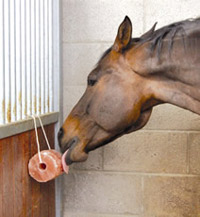 Dr. Christine King - "Horses and other herbivores are meant to get
the minerals they need for health, growth, and reproduction from their
food? Plant material. The more varied the selection of plant materials and
grazing areas, the more able horses are to meet their needs. Sometimes,
though, the available forage does not meet all of their mineral needs,
so they must go in search of other sources of sodium and whatever other
minerals they may be lacking at the time. This salt- or mineral-seeking
behavior leads them to lick rocks, earth, and even each other. Gross and
long-standing dietary deficiencies in phosphorus or protein may even lead
herbivores to chew on the carcasses of other animals.
Dr. Christine King - "Horses and other herbivores are meant to get
the minerals they need for health, growth, and reproduction from their
food? Plant material. The more varied the selection of plant materials and
grazing areas, the more able horses are to meet their needs. Sometimes,
though, the available forage does not meet all of their mineral needs,
so they must go in search of other sources of sodium and whatever other
minerals they may be lacking at the time. This salt- or mineral-seeking
behavior leads them to lick rocks, earth, and even each other. Gross and
long-standing dietary deficiencies in phosphorus or protein may even lead
herbivores to chew on the carcasses of other animals.
 Offering the horse salt and feeding a well-formulated mineral supplement
that is appropriate for the individual horse?s needs should stop the dirt
eating if this behavior is being driven by nutritional deficiency.
My preference for feeding salt to horses is to offer it free-choice, as
loose or block salt in a pan separate from the horse's food. Not a mineral
block; just plain salt. It can be no-frills coarse rock salt or a white
salt block, Redmond salt (a good-tasting natural-source salt whose impurities
give it a pink tinge), or a fancy Celtic sea salt. It doesn't matter all
that much, as long as the product is close to 100% salt (sodium chloride).
Offering the horse salt and feeding a well-formulated mineral supplement
that is appropriate for the individual horse?s needs should stop the dirt
eating if this behavior is being driven by nutritional deficiency.
My preference for feeding salt to horses is to offer it free-choice, as
loose or block salt in a pan separate from the horse's food. Not a mineral
block; just plain salt. It can be no-frills coarse rock salt or a white
salt block, Redmond salt (a good-tasting natural-source salt whose impurities
give it a pink tinge), or a fancy Celtic sea salt. It doesn't matter all
that much, as long as the product is close to 100% salt (sodium chloride).
I prefer not to add salt to the horse's food or put a salt block in
the bottom of the horse's feeder, unless I'm trying to increase the horse's
sodium or water intake for a specific medical reason. The body regulates
its sodium content very closely, as the sodium concentration in the blood
and other body fluids is one of the prime determinants of the body's total
water content. An adequate but not excessive amount of water is essential
for virtually every function in the body, so the body regulates its water
content very closely. In addition to the mechanisms of thirst, drinking
and urination for controlling its water content, the body has a specific
and very refined appetite for sodium. This mechanism is so well regulated
that I prefer to let the horse's body take in as little or as much salt
as it needs at the time, rather than thinking I know better."
Seaweed for Horse Nutritional Support
Kelp is a type of Seaweed that is a source of iodine, vitamins and minerals.
Kelp powder improves skin, coat, and hoof conditions. It is an excellent
source of vitamins and minerals and, it is also high in B-complex and trace minerals.
A Table Spoon of Seaweed a Day Keeps the Vet away! In the US, many horses
spend the winter on grass or alfalfa hay, which becomes less nutritious
through the season. In pastures with degraded soils, micro-nutrient deficiencies
(especially that of selenium) are not uncommon. Horse managers have increasingly
started using dry, powdered seaweed as a source of micro-nutrients for
the animals. Horses fed with powdered seaweed acquire a bloom (glossy
coat and aura of health), resistance to diseases and strength. People with
excitable horses find that this treatment also calms down the animals.
Method of preparation: take seaweed (any type), dry it and grind to a fine
powder. Dosage: Add one tablespoon seaweed per day to the animal's feed.
It may be sprinkled either on cut grass or over grain ration
In the Orkney Islands, through simple observation, it was discovered
that animals grazing on seaweed are generally in better overall condition,
grow faster and have more resistance to illness, especially coughs and
respiratory ailments. As a result of eating seaweed, the now famous North
Ronald say sheep are sought after all over the world by top chefs and restaurants.
When you discover the constituents of seaweed it is easy to see why it
is valued so much.
Richard J. Holliday, D.V.M. - "Always feed a source of kelp ...
free choice if possible. Trace mineral deficient animals will eat a lot
until their needs are met. After that, they consume very little. If they
continue to eat kelp at high levels, it may indicate a more severe deficiency
of one or more individual trace minerals such as Zinc, Copper, Manganese,
Cobalt or others."
Stressed Arabian gelding with arthritis and swollen legs
"Old Arabian gelding "Sam, a 27 year old Arabian gelding. I have had him for 22 years and about 8 years ago at
the age of 19 he had started showing signs of old age. He was showing signs of low energy and stiffness,
it was getting more difficult for him to get up with ease. His back legs would get really swollen. There came a point
where we had to move facilities and to keep him as healthy as possible
I searched for something to prevent and help with the stress of the move,
and that is when I ran across this supplement on Shirley's Wellness Cafe.
I started him on this immune modulating product and continued with the protocol. Much to my surprise he took the move
with great ease and I contribute that to this supplement A little time
had passed and I felt like he needed additional nutrition, so I started him on
marine phytoplankton.
I gave him 2 bottle at the following doses: I started with 4 ounces the first day and second day. I found that I was going
through it so fast and that it wouldn’t last me very long so I decreased it to 2 ounces for the next 3 days and then 1
ounce until it was gone, which was the last 18 days. Totaling 23 days.
I noticed that his energy level improved
greatly and his eyes were bright and he defiantly felt even better. His eyes and his mood tell me a lot about him.
He was much more playful with the other horses…he was so much more engaged with them.
Normally he would stand alone and not do anything, you could tell he just wasn’t in to doing anything.
For example when I let him out in the arena he would go at a much faster pace and throw his head like playful horses do.
Prior to giving him the immune modulating product and marine phytoplankton he was on the normal
feed store grain that you get and everyone follows.
I quickly realized that none of it was benefiting him at all, especially the senior feeds and grain mixes that most
western vets recommend and horse owners use today. He has had shoes on his feet for most of his life, which have caused a
great deal of damage. He has been bare foot now for about 9 months. It will take some time to repair the damage the steel
shoes caused to his feet but the immune support has certainly played a huge role in getting him through the tough beginning
stages of his feet starting to heal and continue to help long term. His feet are still very tender but improve greatly with time."